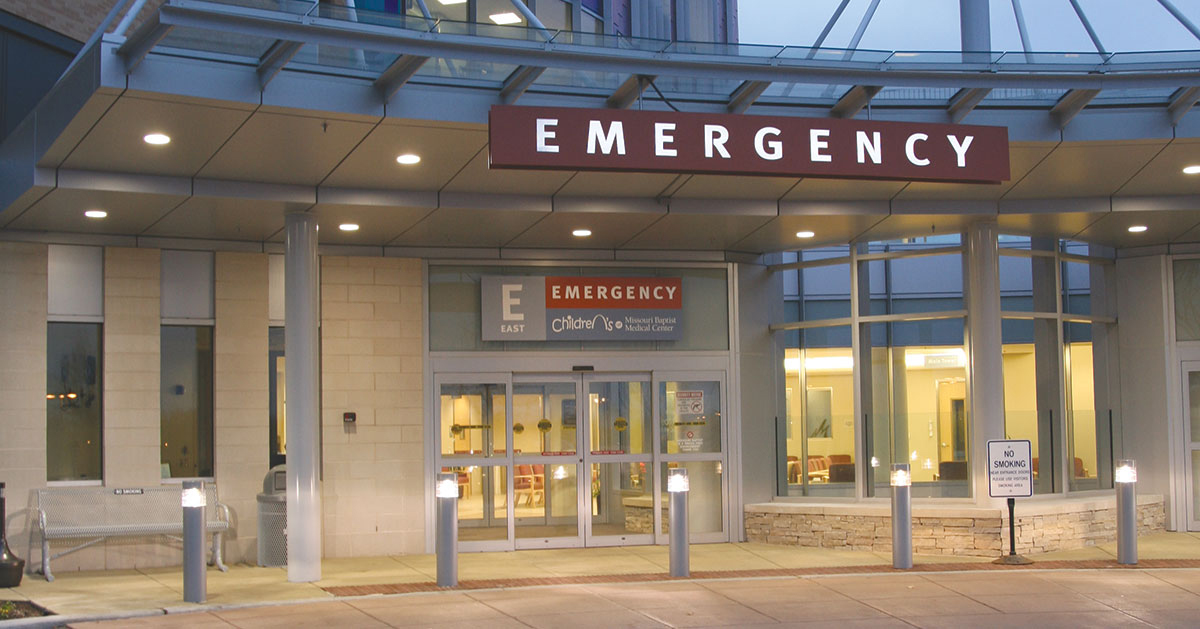
Every second counts during a medical emergency. At the Missouri Baptist Medical Center Emergency Department, we deliver excellent care in efficient fashion. From our kid-friendly pediatric emergency unit to our nationally recognized geriatric care, you and your loved ones will find the support you need in a convenient location that values you and your time.
Specialized services
Child-focused, family centered children’s Emergency Department
Our pediatric emergency unit is staffed 24/7 by Washington University pediatricians and specialty trained pediatric nurses from St. Louis Children’s Hospital. Learn more about the special care in our Children’s ER.
Leading-edge, nationally recognized geriatric care

Our Emergency Department earned a bronze Level 3 accreditation for geriatric care from the American College of Emergency Physicians (ACEP). It was among the first of five Missouri hospitals to earn this accreditation, which recognizes Emergency Departments that provide exceptional care for older adults. From innovations that prevent falls to the availability of follow-up home health visits after discharge, our Emergency Department continues to enhance the care we provide our communities. Learn more about this accreditation.
Atrial fibrillation program
Our atrial fibrillation (a-fib) program quickly connects patients experiencing a-fib, a condition where the heart beats irregularly, to a team of BJC Medical Group heart specialists who will oversee their care. The team also provides additional support to help reduce long-term complications related to a-fib.
When to go to the Emergency Department
These medical conditions or symptoms require an immediate trip to the Emergency Department:
- Chest pain or discomfort, nausea, and shortness of breath; these are signs of possible heart attack
- Numbness in the face, arm, or leg; sudden confusion; dizziness; blurred vision—these are signs of possible stroke
- Broken bones
- Dehydration associated with persistent vomiting or diarrhea
- High fever that can't be controlled by aspirin or ibuprofen
- Major burns
- Severe cuts with uncontrolled bleeding
- Severe allergic reactions to foods or insects
Call 911 if someone is experiencing a life-threatening condition like a heart attack, stroke, or appears unresponsive.
Know before you go
We understand the stress that can accompany waiting in an Emergency Department. You deserve extraordinary care, and we want to treat you and your loved ones as quickly as possible. Please note that longer wait times can occur when we are experiencing high patient volumes in the Emergency Department.
Patients in our Emergency Department are in different stages of their care. You may be taken to certain areas of the Emergency Department depending on your condition and treatment plan. You may be asked to sit in a waiting room between receiving test results or additional treatments.
Please bring a photo ID and recent insurance card to expedite registration. Thank you for your patience. Our team will keep you updated after you arrive. At any time, if you experience worsening symptoms, questions, or concerns, please notify us.
Other BJC care options to meet your needs
Virtual Care: Connect with a doctor or nurse directly on your phone, tablet, or computer by scheduling a virtual care appointment. Click here to learn more.
Convenient Care: BJC’s Convenient Care offers same-day expert care for minor illnesses. Find a Convenient Care location near you.